|
|
|
| synonyms: Dyeball, Erbsenstreuling, Osztott pöfeteg, Pisolithus tinctorius |
|
|
|
|
| location: North America, Europe |
| edibility: Inedible |
| fungus colour: Yellow, Brown, Grey to beige |
| normal size: 5-15cm |
| cap type: Other |
| stem type: Lateral, rudimentary or absent |
| flesh: Flesh granular or brittle |
| spore colour: Light to dark brown |
| habitat: Grows on the ground |
|
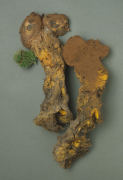
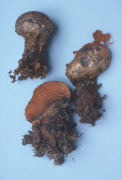
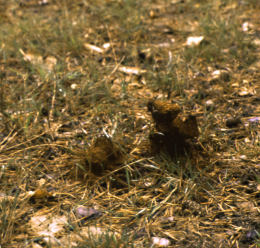
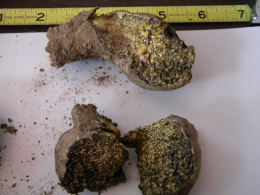
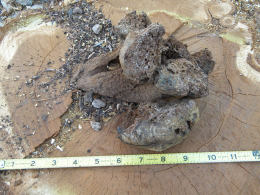
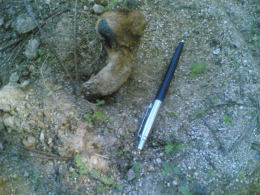
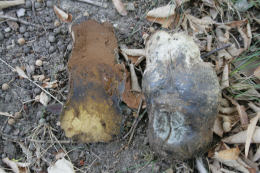
Pisolithus arrhizus (Pers.) Rausch. syn. P. arenarius A. & S. syn. P. tinctorius (Mich. ex Pers.) Coker & Couch Erbsenstreuling Osztott pöfeteg Dyeball. Fruit body 6–12cm across, 5–25cm high, narrowing below into a thick stem-like base submerged in the ground, ochraceous to olive-brown and resembling balls of horse dung lying on the ground, with chrome yellow markings on the submerged part, outer wall very thin becoming brittle at maturity and readily breaking apart to expose the dark brown stony, gravel-like peridioles: pea-shaped structures which contain the spores. Spores cinnamon-brown, globose, warted, 7–11.5m in diameter. Habitat in sandy or well-drained gravelly soil in fields or roadsides. Season autumn. Very rare. Not edible. Distribution, America and Europe. The third and fourth photographs are from the collections of Ted Green. |
|
Members' images and comments
|
Click here
to upload and share your photos and comments about this mushroom (JPEG only please).
|
|
|
|
Rita Leonard (United States) - 18 October 2013
here is a smaller one from the back yard, are these poisioness or harmful to my dog?
|
|
|
Rita Leonard (United States) - 18 October 2013
found about 6 in my back yard, glad to identify them. I live in the high desert in California.
|
|
|
Joaquim Villas-Boas (Portugal) - 15 September 2011
Found in Quinta de S. Joao -
Casal - 3515-787 Ribafeita - Viseu Portugal
|
|
|
Rosen Aleksov (Bulgaria) - 15 September 2011
I found this mushroom on a central boulevard in Blagoevgrad, Bulgaria on 15.09.2011
|
|
|
|
|
|
By uploading images and text you hereby warrant that you are the legal owner of this
material and agree, without limitation, to permit Rogers Plants Ltd to publish such
images and text on this Rogers Plants website. Rogers Plants Ltd reserves the right
to remove any member images or text at its sole discretion.
|