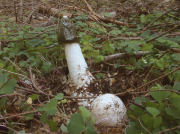
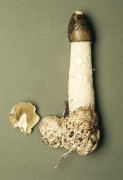
Phallus impudicus Pers. syn. Ithyphallus impudicus (L.) Fr. Gemeine Stinkmorchel Phallus Impudique, Satyre puant, Oeuf du diable, Stinkhorn. Fruit body initially semi-submerged and covered by leaf-litter, egg-like, 3–6cm across, attached to substrate by a cord-like mycelial strand. The outer wall of the egg is white to pinkish but there is a thick gelatinous middle layer held between the membranous inner and outer layers. The egg is soon ruptured, as the white hollow stalk-like receptacle extends to 10–25cm high, the pendulous, bell-shaped head is covered by a meshwork of raised ribs covered in dark olive slime which contains the spores. This slime has a strong sickly offensive smell which attracts flies from large distances, the slime sticks to the legs of the flies and thus acts as a means of spore dispersal which takes place very rapidly, exposing the underlying mesh of the cap. Spores pale yellow, oblong, 3.5–4 x 1.5–2µ. Habitat associated with rotting wood which may be buried in the soil, in gardens and woodland. Season summer to late autumn. Very common. The egg stage, which lacks the disgusting smell, is edible though not tasty; it is said to be an aphrodisiac presumably through association with its phallic shape. Distribution, America and Europe. The second picture was taken by Geoffrey Kibby. |