Lactarius deceptivus Pk.
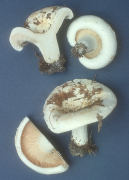
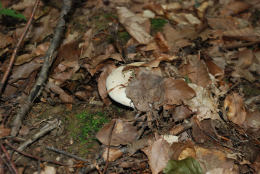
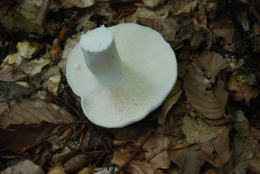
Cap 5-20 cm across, convex becoming depressed then funnel-shaped, with an inrolled margin covered in thick, cottony tissue that sometimes partially covers the gills; whitish staining brown with yellowish patches; dry, smooth, but dull becoming scaly in age. Gills adnate-decurrent, close to subdistant, moderately broad; ivory to ochre, bruising tan. Stem 40-90 x 10-35mm, hard, solid, sometimes tapering toward the base; white, staining brownish; dry, velvety, becoming scaly in age. Flesh firm, thicker at center of cap; white. Latex white, unchanging, staining flesh brownish. Odor mild becoming strong. Taste strongly acrid. Spores ovate to subglobose, amyloid, 9.5-12 x 7.5-10µ; ornamented with isolated warts and spines, prominences 0.5-1µ high. Deposit white to pale yellowy buff. Habitat gregarious on soil in mixed or deciduous woods near hemlock or oak, and in moss in coniferous woods. Common. Found widely distributed from central North America eastward to the Atlantic. Season June-September. Not edible. This species has been considered edible if thoroughly cooked to remove bitterness. (Never eat any mushroom until you are certain it is edible as many are poisonous and some are deadly poisonous.) |