|
|
 |
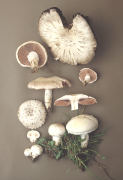
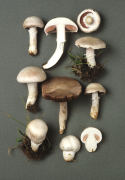
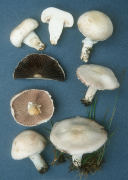
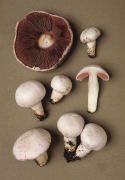
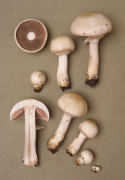
Agaricus campestris.
Click a photo to enlarge it.
back to list
|
|
|
| synonyms: Agaric champêtre, Feldegerling, Field Mushroom, Kerti csiperke, mezei csiperke, Pink Bottom, Rosé de prés, Wiesenchampignon |
|
|
|
|
| location: North America, Europe | | edibility: Choice | | fungus colour: White to cream | | normal size: 5-15cm | | cap type: Convex to shield shaped | | stem type: Ring on stem | | spore colour: Purplish to black | | habitat: Grows on the ground, Found in fields, lawns or on roadsides
|
|
Agaricus campestris L. ex Fr. syn. Psalliota campestris (L. ex Fr.) Quél. Field Mushroom, Pink Bottom, Agaric champêtre, Rosé de prés, Kerti (mezei) csiperke, Wiesenchampignon, Feldegerling, Prataiolo, prataiolo bianco, Weidechampignon.
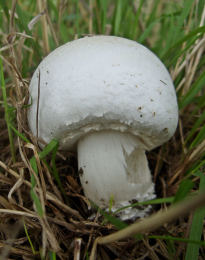
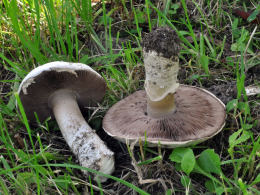
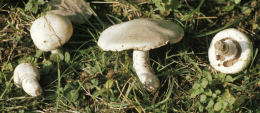
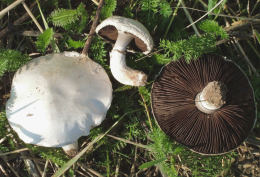
Cap 3–10cm across, domed and remaining so a long time before expanding fully, white sometimes creamy yellow, scaly or smooth. Stem 30–100 x 10–15(20)mm, white sometimes yellowing slightly towards the tapered base; ring thin and white, short-lived, often little more than a torn frill. Flesh white, bruising faintly pink especially above the gills. Taste and smell pleasant and mushroomy. Gills deep pink even in unopened ‘buttons’, finally darkening to brown. Cheilocystidia lacking. Spore print brown. Spores ovoid, 7–8 x 4–5µ. Habitat in pastureland. Season late summer to autumn. Frequent. Edible – excellent. Distribution, America and Europe. Comment There are some other, almost identical species best distinguished by their microscopic features: Agaricus andrewii, with large marginal cystidia on the gills (campestris has none), and Agaricus solidipes, with spores up to 10 x 6µ. |
Mushroom Recipes |
| Mushroom Croustade |
| Scallops with Mushroom Sauce |
| Soufflé Flan with St George's Mushroom Filling |
|
Members' images and comments
|
Click here
to upload and share your photos and comments about this mushroom (JPEG only please).
|
|
|
|
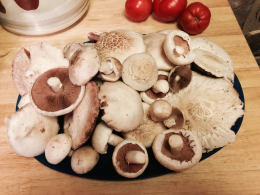
brian fab (United States) - 14 September 2015
Found growing all over a 55 plus condominium community. A total haul
of almost 75 pounds.
|
|
|
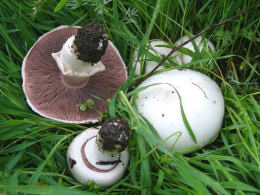
Dejan Stojanovic (Yugoslavia) - 10 June 2011
AGARICUS CAMPESTRIS - Site in the area Zaplanje (city of Nis), Southern Serbia, SERBIA.
|
|
|
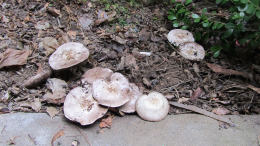
Chris Kistner (United States) - 14 October 2010
I found these in my yard where there is a lot of detritis. They smell great and and seem to bruise easy. I live in San Diego, California and the weather has been cool and wet lately.
|
|
|
Ashley Watson (United Kingdom) - 05 September 2010
Leicestershire England, August 2010.
|
|
|
Mirosław Wantoch-Rekowski (Poland) - 16 June 2010
Rondo - zieleniec na Osiedlu M³odych.Gdañsk Oliwa
|
|
|
Lorand Bartho (Hungary) - 03 February 2009
|
|
|
Lorand Bartho (Hungary) - 03 February 2009
Hungarian names, Kerti csiperke, Mezei csiperke
|
|
|
|
|
|
By uploading images and text you hereby warrant that you are the legal owner of this
material and agree, without limitation, to permit Rogers Plants Ltd to publish such
images and text on this Rogers Plants website. Rogers Plants Ltd reserves the right
to remove any member images or text at its sole discretion.
|
|