The mushrooms


support our next site RogersFlowers.com

Inonotus obliquus.   Click a photo to enlarge it.   back to list

synonyms: Birch Conk, Chaga, Clinker Polypore
Inonotus obliquus Mushroom
Ref No: 6713
Buy this image
location: North America, Europe
edibility: Inedible
fungus colour: Black or blackish
normal size: 5-15cm
cap type: Other
stem type: Lateral, rudimentary or absent
flesh: Pore material cannot be seperated from flesh of the cap
spore colour: Light to dark brown
habitat: Grows in woods, Grows on wood

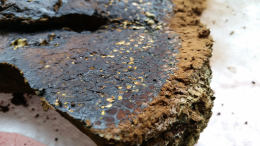
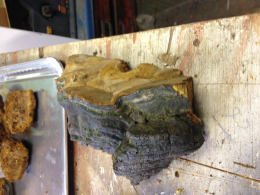
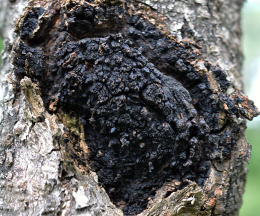
Inonotus obliquus (Fr.) Pilat Birch Conk, Chaga, Clinker Polypore, Fruit body sterile conk 25-40cm across; black; deeply cracked, very hard and brittle when dry. Fertile portion 5m thick, crust-like, thin; dark brown. Tubes 3-l0mm deep, brittle, usually split in front. Pores 6-8 per mm, circular; whitish becoming dark brown. No stem. Flesh corky, faintly zoned; bright yellowish brown. Spores broadly ellipsoid to ovoid, smooth, 9-10 x 5.5-6.5µ. Setae present. Habitat beneath the bark or outer layers of wood on living, dead, standing, or fallen trees, erupting into conspicuous black conks, generally on birch, elm, and alder. Found in northern North America, and northern Europe to Russia. Season all year. Not edible although it comes highly recomended for cancer treatments, it is this fungus that is discussed by Solzhinitsyn in his book 'The Cancer Ward', a tea made from the fungus is drunk daily, the fungus has been found to contain inotodiol which has active anti-tumor properties. (It is only the specimens growing on Birch trees that seem to have this property). It has also been shown to have antiviral activity against HIV.

Members' images and comments

Click here to upload and share your photos and comments about this mushroom (JPEG only please).
Amy Rebella (United States) - 30 October 2011

Update on my photo. It is incorrectly named. This and the one listed below by the gentleman Mr. Ian Dubelaar from Canada - 08 January 2011, is not a Chaga, but in fact a Phellinus igniarius. I was corrected by an expert in mycology.
Amy Rebella (United States) - 07 July 2011

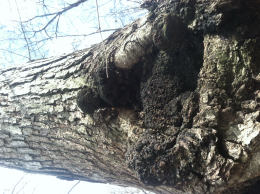
I found a 2+ lb. Chaga Conk on what I believe now to be a "sweet birch (black birch). I was on a mission to find one for my cousin who is an herbalist and I was in the woods of northern Wisconsin for the weekend. Something just made me walk right to it. Of course, I ended up taking it off the tree, but I didn't realize that I had something that was rare until I came to this site. I wish I didn't take it off the tree! Afterwards, my husband and I went back to the tree and took pictures of where we found it, how it was placed and what it looked like. I still have it and am not sure if it's of any scientific use to anyone rather than have it made into a tincture or tea. Can the fruiting body be saved and "infect" another tree to reproduce? It appears to be dying and I am pretty sad about it. If anyone is interested please let me know before I hand it off to be destroyed!
Inonotus obliquus
mike ponchaud (United States) - 15 February 2011

10lb Chaga!!! Yellow Birch Crystal Falls, MI
Inonotus obliquus
Mirosław Wantoch-Rekowski (Poland) - 23 January 2011

Gdansk Przymorze Poland
Inonotus obliquus
Ian Dubelaar (Canada) - 08 January 2011

This inonotus obliquus is sporting what appears to be a fertile sporocarp at its lower end. I have never seen this before on and chaga. Does anyone have any information on this?
Inonotus obliquus
By uploading images and text you hereby warrant that you are the legal owner of this material and agree, without limitation, to permit Rogers Plants Ltd to publish such images and text on this Rogers Plants website. Rogers Plants Ltd reserves the right to remove any member images or text at its sole discretion.
© 2001-2012 Rogers Plants Ltd. All rights reserved. The text and photographs on this site may not be reproduced in any form without the written permission of Rogers Plants Ltd. Please see our Terms and Conditions. Site by Glide Technologies Ltd. Poisoning Disclaimer.
Don't forget to visit our sister sites RogersRoses and RogersTreesandShrubs.