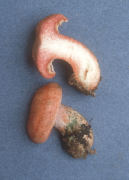
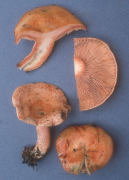
Lactarius rubrilacteus Smith & Hesler. Cap 6-12cm across, broadly convex to flat with a depressed disc and inrolled margin, becoming broadly funnel-shaped with upturned and wavy margin; bright carrot orange or dull pinky-orange with green stains or patches in older specimens, arranged in concentric bands of color; smooth, sticky. Gills adnate to short decurrent, close to crowded, narrow to moderately broad; light, dull pinky-brown to dull purple-red, stained greenish in age. Stem 20-60 x 10-30mm, firm and rigid, hollow, slightly tapering toward the base; similar color to cap; sometimes pitted. Flesh dirty yellowish white, staining green with age. Latex dark scarlet to purple-red in young specimens, paler and more orangy red in older specimens, scanty. Odor very faintly aromatic. Taste mild or a little bitter. Spores broadly ellipsoid, amyloid, 7.5-9 x 6-7.5μ; ornamented with warts and bands forming a partial reticulum, prominences 0.2-0.4µ high. Deposit cream. Habitat scattered to gregarious under conifers, especially pine. Common. Found widely distributed in western North America. Season June-October. Edibility not known - avoid. |