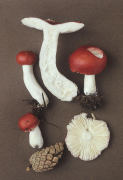
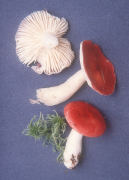
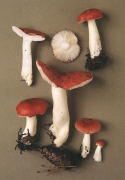
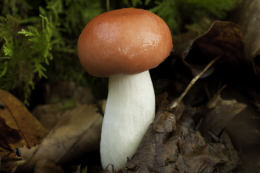
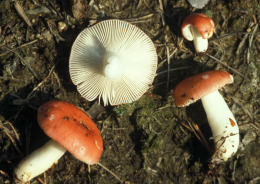
Russula emetica (Schaeff. ex Fr.) S.F. Gray. Sickener, Emetic Russula, Russule émétique, Colombe rouge, Kirschroter Speitäubling, Hánytató galambgomba, Colombina rossa, rossetta, Berijpte russula. Cap 3–10cm across, convex, later flattening or with a shallow depression, scarlet, cherry or blood red, sometimes with ochre-tinted to white areas, somewhat thin-fleshed, fragile, shiny, sticky when moist; skin easily peeling to show pink to red coloured flesh beneath, margin often furrowed when old. Stem 40–90 x 7–20mm, white, cylindrical or more usually somewhat swollen towards the base, fragile. Flesh white, red immediately beneath cap cuticle. Taste very hot, smell slightly fruity. Gills adnexed to free, cream then pale straw. Spore print whitish (A). Spores broadly ovoid; with large warts, 1.2µ high, connected by fine lines to form a large-meshed, almost complete network, 9–11 x 7.5–8.5µ. Cap cystidia mostly narrowly club-shaped with 0–1 septa. Habitat under pines. Season summer to late autumn. Common. Poisonous. Distribution, America and Europe. |