|
|
 |
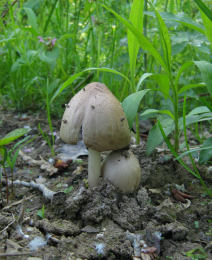
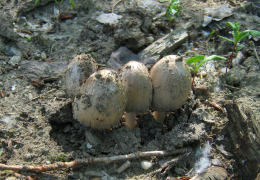
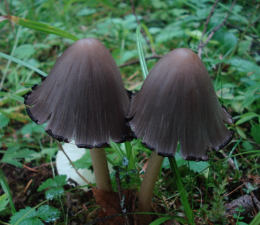
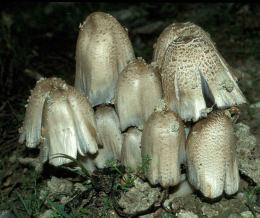
Coprinus atramentarius.
Click a photo to enlarge it.
back to list
|
|
|
| synonyms: Common Inkcap, Coprin noir d'encre, Grauer Faltentintling, Ráncos tintagomba, Tippler's Bane |
|
|
|
|
| location: North America, Europe | | edibility: Poisonous/Suspect | | fungus colour: White to cream | | normal size: 5-15cm | | cap type: Conical or nearly so | | stem type: Ring on stem | | spore colour: Purplish to black | | habitat: Grows in woods, Grows on the ground, Grows on wood |
|
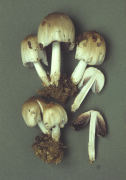
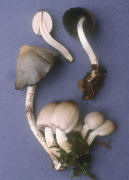
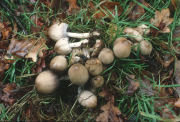
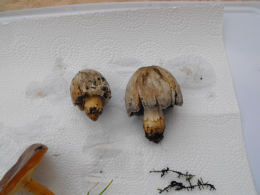
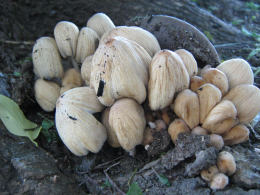
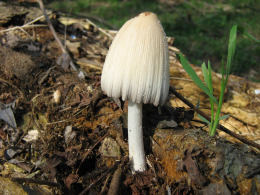
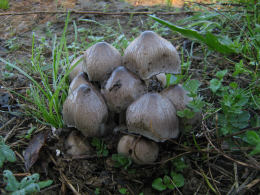
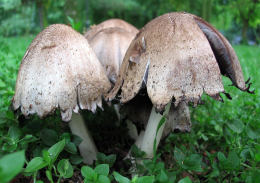
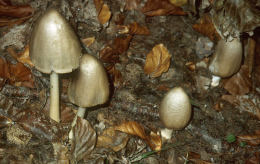
Coprinus atramentarius (Bull. ex Fr.) Fr. Common Inkcap, Tippler's Bane, Coprin noir d'encre, Grauer Faltentintling, Fungo dell'inchiostro, Kale inktzwam, Ráncos tintagomba. Cap 3-7cm high, ovoid at first, then broadly conical when expanded, with the margin irregularly puckered at first, then becoming split; gray to gray-brown; dry, smooth or silky with minute scales or veil remnants, especially near the center. Gills free, crowded, broad; white then lavender-gray then inky black and soon deliquescing. Stem 70-170 x 9-20mm, hollow; whitish; dry, silky-fibrous; fibrous white partial veil leaving ring zone near base. Odor faint and pleasant or none. Spores ellipsoid, smooth, with pore at tip, 7-11 x 4-6µ. Deposit black. Habitat usually in clusters on the ground near rotting or buried wood or in grass. Found widely distributed throughout North America and Europe. Season May-September (November-April in California). Edible but dangerous because it causes alarming symptoms (nausea, palpitations) when taken in conjunction with alcohol; indeed, it has been given to alcoholics to cause these symptoms and eventually cure their habit. Comment Good black drawing ink used to be made from the deliquesced caps by boiling the black "ink" with a little water and cloves. |
|
Members' images and comments
|
Click here
to upload and share your photos and comments about this mushroom (JPEG only please).
|
|
|
|
philip johnston (United Kingdom) - 07 December 2012
|
|
|
Marjan Kustera (Yugoslavia) - 28 June 2012
Find and photo taken by Marjan Kuštera,
SERBIA,Mushroom Society of Niš.
|
|
|
Marjan Kustera (Yugoslavia) - 29 May 2011
Find fungus and photo taken by
Marjan Kuštera,Serbia,Niš.
|
|
|
Slobodan Nikolic (Yugoslavia) - 10 February 2011
|
|
|
MirosĊ‚aw Wantoch-Rekowski (Poland) - 29 October 2010
18/06/2006 Sopot Park Po³udniowy.Poland
|
|
|
Slobodan Nikolic (Yugoslavia) - 03 May 2010
|
|
|
Slobodan Nikolic (Yugoslavia) - 03 May 2010
|
|
|
Trevor Clayton (United States) - 24 December 2008
Olympic Peninsula, Washington
|
|
|
Lorand Bartho (Hungary) - 17 November 2008
|
|
|
Lorand Bartho (Hungary) - 16 November 2008
Alcohol (ethyl alcohol) is oxidised in two enzymatic steps in the mammalian body (mainly the liver). Acetaldehyde is formed first and then acetic acid. The second reaction is quicker, so only minute amounts of acetaldehyde are present in any point of time. Coprin (of the Common inkcap), the drug Antabuse and a few other compounds inhibit the second reaction, hence the plasma level of acetaldehyde increases. The syndrom caused is called Antabuse-reaction or acetaldehyde syndrom. It is not particularly dangerous (but unpleasant) to healthy people but may be more so for patients having, e.g., circulatory diseases.
|
|
Lorand Bartho (Hungary) - 16 November 2008
|
|
|
|
|
|
By uploading images and text you hereby warrant that you are the legal owner of this
material and agree, without limitation, to permit Rogers Plants Ltd to publish such
images and text on this Rogers Plants website. Rogers Plants Ltd reserves the right
to remove any member images or text at its sole discretion.
|
|