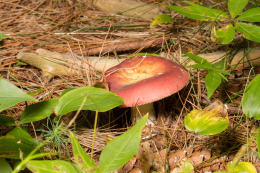
Russula decolorans (Fr.) Fr. Orangeroter Graustieltäubling, Tarkahúsú galambgomba, Russule décolorée, Copper Brittlegill
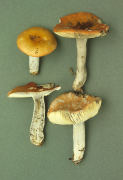
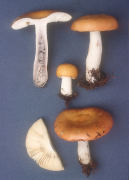
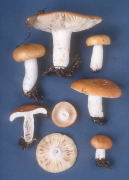
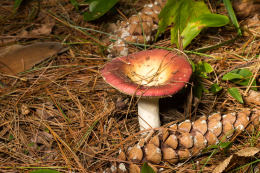
Cap 4.5–11cm across, subglobose at first then convex and flattening, finally with a depression, brownish red or orange, reddish sienna, tawny or cinnamon, staining black or brown, firm, sticky when moist, peeling at margin only; margin finally furrowed. Stem 45–100 x 10–25mm, white, greying strongly, firm, often with club-shaped base. Flesh thick, greying strongly on exposure. Taste mild. Gills adnexed, pale ochre, blackening, connected by veins at their bases. Spore print deep cream to pale ochre (E or F). Spores ovoid to elliptic with spines of various heights up to 1.5µ, mostly isolated but some connected by thin lines to form a very incomplete network with only 1–2 meshes, 9–14 x 7–12µ. Cap surface with numerous slightly club-shaped dermatocystidia with one or no septa. Habitat under conifers. Season summer to autumn. Uncommon in the UK – confined to the Highland region of Scotland. Edible. (Never eat any mushroom until you are certain it is edible as many are poisonous and some are deadly poisonous) Distribution, America and Europe. |