|
|
 |
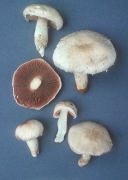
Agaricus andrewii.
Click a photo to enlarge it.
back to list
|
|
|
|
|
|
|
| location: North America | | edibility: Choice | | fungus colour: White to cream | | normal size: 5-15cm | | cap type: Convex to shield shaped | | stem type: Ring on stem | | spore colour: Purplish to black | | habitat: Grows on the ground, Found in fields, lawns or on roadsides
|
|
Agaricus andrewii Freeman False Meadow Mushroom Cap 2-6cm across, convex then flattened, but with inrolled margin until fully mature; pure white, to cream when old; smooth, silky-fibrillose, margin of cap with floccose remnants of white veil. Gills free, crowded, broad; bright pink when young, then soon chocolate brown, and finally black. Stem 25-50 x 10-15mm, equal to tapered at the base; white; fibrillose to woolly below the faint evanescent ring zone. Flesh firm; white. Odor very pleasant. Taste very pleasant. Spores broadly ellipsoid, 7-8 x 4-5µ. Deposit purplish brown. Marginal cystidia sparse, prominent and turnip-shaped to club-shaped. Habitat As yet the exact distribution of this species is uncertain because of confusion with Agaricus campestris. However, it would appear to be widespread at least in eastern north America as far south as North Carolina. Season late September-November. Edible and choice, it has doubtless been mistakenly collected many times as Agaricus campestris. Comment The more familiar Agaricus campestris lacks any marginal cystidia and may not be as common in America as is usually supposed. Apart from the microscopic differences, Agaricus andrewii would appear to differ hardly at all macroscopically, except that it seems to have a more consistently smooth and purer white cap than Agaricus campestris. |
|
Members' images and comments
|
Click here
to upload and share your photos and comments about this mushroom (JPEG only please).
|
|
|
|
Harry Swihart (United States) - 15 August 2011
Harry Swihart Cassopolis, Michigan 15Aug11
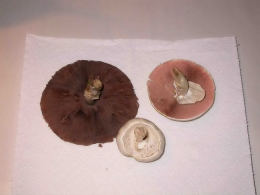
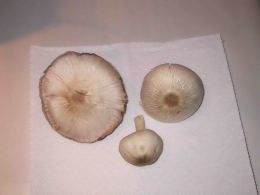
Second photo of Agaricus Andrewii showing spore side of previous photo of caps.
|
|
|
Harry Swihart (United States) - 15 August 2011
Harry Swihart Cassopolis, Michigan 15Aug11
I believe these are Agaricus Andrewii found in the grass, next to a woods. The 3 shown were wihtin 18 inches of each other and again I believe they show three stages of growth. The smallest with inrolled conical cap is 5 cm width and white spores, the middle size has pink spores and the largest is 12 cm width with dark brown spores and flattened cap outrolled at edges. The middle size has a stocking like ring and all 3 sizes have a slightly flattened cap at the center that is wrinkled, not smooth.
|
|
|
Joan Butler (United States) - 29 September 2010
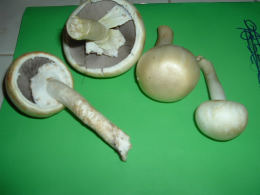
Picked today in lawn 10,28,10 Tops were white,now tan, extremely firm. No smell.
Look delicious.
Joan Butler
|
|
|
|
|
|
By uploading images and text you hereby warrant that you are the legal owner of this
material and agree, without limitation, to permit Rogers Plants Ltd to publish such
images and text on this Rogers Plants website. Rogers Plants Ltd reserves the right
to remove any member images or text at its sole discretion.
|
|